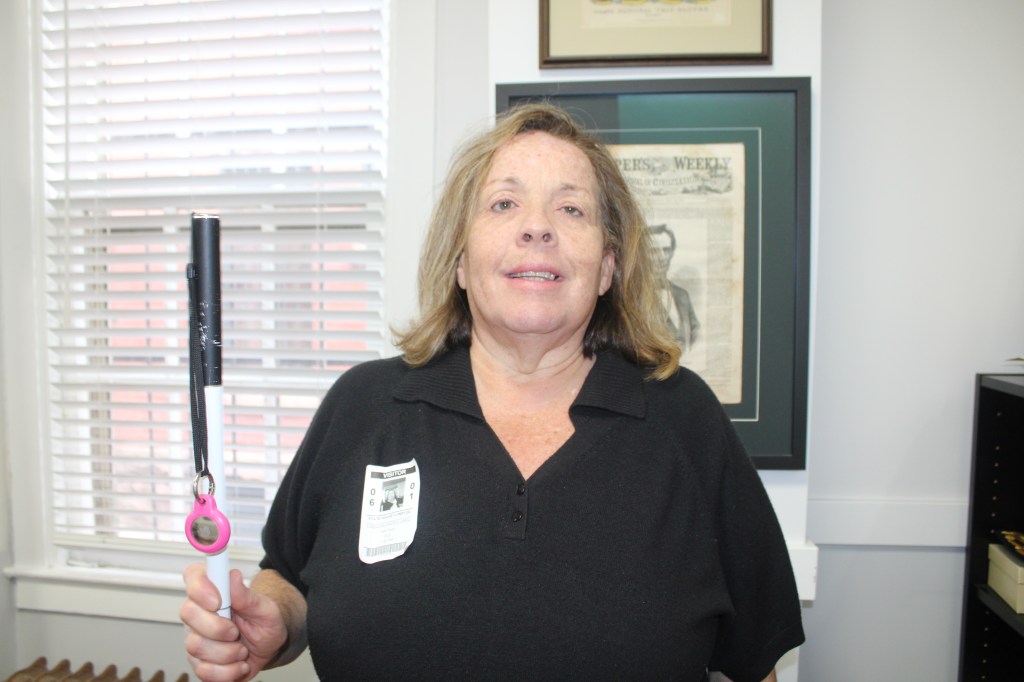
Linda Melendez, president of the National Federation of the Blind of New Jersey, advocates for driverless cars. She says the technology would be liberating for her. Photo credit: Lucy Harper / NJ State House News Service.
By Devon Williams and Lucy Harper
NJ State House News Service
Linda Melendez paints a vibrant picture of autonomous vehicles, a future that is not cold and robotic but instead liberating and empowering for the 65-year-old, who is blind.
The Keyport woman has a hereditary condition that led to loss of eyesight in her late 30s. She and her two sisters were born with sight only in one eye, and doctors warned the seeing eye would also one day go dark.
Melendez says that transportation has remained one of the most stark barriers between her and the independence she wants and feels she needs for her family.
With a bill establishing trial testing for self-driving cars in New Jersey pending in the legislature, those with disabilities may become some of the biggest beneficiaries of the program.
The legislation is deeply meaningful for Melendez. “I can live where I want to live. … I can work where I want to work,” she says. “I can do the things that I want to do with my grandson.”
Last month, Melendez – who has been the president for the National Federation of the Blind of New Jersey since 2020 – testified before Trenton lawmakers for bill A3968. The measure would allow autonomous vehicles like Waymo to test in secure, non-public locations with the intention to later introduce driverless cars to public roads after multiple rounds of trial periods.
While much of this public debate has centered on safety, oversight, and crash tests and reporting that inform the effect that driverless cars could have on transportation jobs nationwide, Melendez sees self-driving cars as a path to freedom.
“I haven’t been spontaneous since 1998,” Melendez said of the year she went blind. With new transit on the horizon, she expressed how excited she was to “become spontaneous again.”
The biggest benefit for Melendez of more accessible transit is her role as a mother and grandmother.
When her grandson first asked her what it means to be blind, Melendez said she “could see enough, because I had 20 over 201 in one eye, … his eyes lit up with tears, and just anguish like it was a death sentence.”
“It’s OK to be blind, it’s OK that Nana can’t see,” Melendez responded. “We still get your Oreos don’t we?”
Even this small example of mobility and ability changed both the way Melendez viewed her own life.
When Melendez’s mother realized how bad Melendez’s vision was becoming 20 years ago, she again was afraid that this was a ‘death sentence.’
Her mother urged her to move back home, afraid she couldn’t raise her son alone, but Melendez refused.
“I said, I can’t do that, Mom, I can’t do that, because when you die, if the circle of life goes the way supposed to, you will leave me on this Earth.” she said. “If I have to learn how to live without you… I’m not gonna make it. I won’t make it.”
Melendez believed it was necessary to push through independently and teach herself how to be a mother on her own, despite the changing way she navigated the world.
Now, for Melendez, the advent of self-driving vehicles raises the possibility that those who cannot drive can finally find another way to move throughout the world without planning ordinary trips days in advance, navigating a web of trains, buses and ride-hailing apps, or even avoiding ride-share cancellations over driver concerns of allowing a service animal.
What others once believed to be a “death sentence,” Melendez sees a “liberating” future as a result of autonomous vehicles. In telling her story, Melendez focuses not on crash statistics, sensors, or state regulations, but instead on her 7-year-old grandson, Lucas.
“It would be liberating to be able to privately and independently take my grandson where he needed to go,” she said.
Melendez explained that getting to and from public transportation can be hard to navigate, and the wait times and expense of taxi and ride-share services are challenging.
“Lyft and Uber are very difficult to deal with,” Melendez said.
“New Jersey has the opportunity to lead the northeast in developing safe and efficient autonomous vehicle technology that will revolutionize how we travel,” said Sen. Andrew Zwicker, a Democrat from South Brunswick, a sponsor of the measure.
Another sponsor, Sen. Gordon Johnson, a Democrat from Englewood, said, “This program establishes strong safeguards and clear oversight measures that will allow the state to responsibly evaluate the technology without risking the safety of our communities.”
Waymo, one of the country’s leading autonomous vehicle companies, argues that this service can offer a different kind of independence than traditional ride-share because the rider does not have to rely on human fallibility for accepting rides or driving safely.
“Accessibility has been core to Waymo’s product since the very beginning,” said
Ethan Teicher, a Waymo spokesperson.
According to Waymo, advantages for disabled passengers like Melendez include app-based audio and vibration cues to find the car, the ability to make the vehicle play a sound or honk when near the vehicle and the ability to reach human support at any time through the app or passenger screen.
“Look at the message this will send Lucas,” Melendez said. “He’s learning about blindness… This is going to change his perspective on life.”
For blind riders, the absence of a human driver can be a double-edged sword. It can remove the risk of discrimination from drivers who refuse riders with guide dogs or do not understand how to assist visually impaired passengers, yet it also removes a person who may provide directions, connection through conversation, or help in unfamiliar pickup locations.
Waymo contends a lack of reliable transportation is already a barrier to human connection for many blind and elderly Americans, and that independent travel can make people more active participants in their communities.
Still, autonomous vehicles may inherit some of the same limits as ride-share services. Waymo said its rides are dynamically priced and “competitive,” rather than cheaper. The company also said pickup and travel times can vary depending on road conditions, according to Teicher, the Waymo spokesperson.
Still, Melendez, describes autonomous vehicles not as a cure-all, but as a chance to restore the basic ability to decide on her own where she wants and needs to go.
She said the impact would extend beyond her own life, showing her grandson that blindness does not have to mean dependence.
“Blindness is not a death sentence,” Melendez said. “With technology, confidence, and training, we can achieve any of our goals.”
Devon Williams is a student at Princeton University, majoring in comparative literature with concentrations in Italian and Spanish. She is a journalism minor. Lucy Harper is a Princeton University major in history and a minor in journalism.

