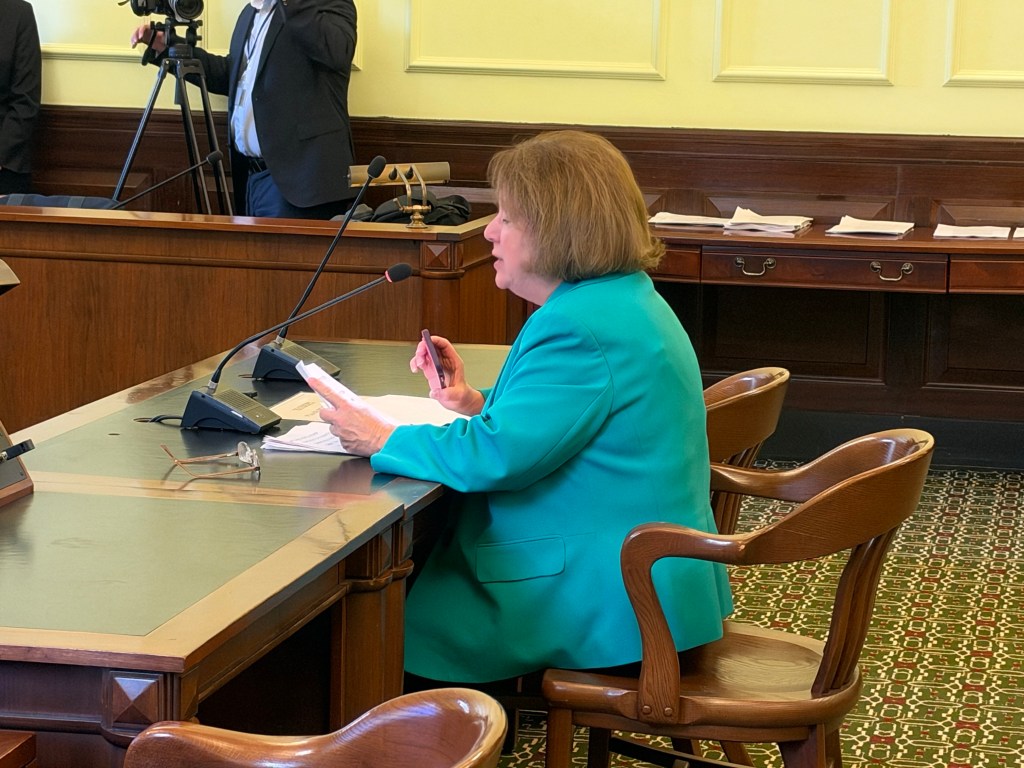
Sen. Linda Greenstein, a Democrat from Plainsborough, testifies Thursday in support of her bill requiring public transparency in data center development. Photo credit: Shohini Mitra/NJ State House News Service.
By Shohini Mitra
NJ State House News Service
TRENTON, N.J. – A Senate committee advanced a bill Thursday aimed at increasing transparency around proposed data center development.
Sponsor Sen. Linda Greenstein, a Democrat from Plainsborough, said the issue is personal – a giant South Brunswick data center is set to be built next to her hometown.
“I’ve tried to find out information for a year and I haven’t been able to find out anything.” Greenstein testified Thursday about the secretive process. “People are not giving me any information, so you can imagine that they are not giving people in the towns any information. I think it’s really disgraceful.”
Bill S4304 would ban data center developers and their agents from entering into agreements, including nondisclosure agreements, that conceal development plans or prevent public review. The bill would take effect immediately if it is passed by the full Senate and Assembly, and signed by the governor.
Under the measure, hiding such development or preventing the public from reviewing data center plans through signed nondisclosure agreements would become unenforceable under state’s Municipal Land Use Law.
This law governs how municipalities regulate planning, zoning and property development.
Sen. Holly Schepisi, a Republican attorney from River Vale, voiced her concern regarding the bill.
“Every commercial deal, regardless of what it is, has [nondisclosure agreements,]” Schepisi said. “It’s standard practice. I have yet to see a deal of any sort of magnitude not have one. They are extraordinarily important for purposes of negotiating, having terms, exclusivity periods, and the like.”
But Greenstein said data center developments were avoiding public scrutiny: “I have never seen anything with such a lack of transparency in my entire life. I am beyond frustrated with trying to get information on these projects.”
The bill includes numerous provisions for data centers and municipal agencies to follow.
Data center applicants must attest that no party involved in the property transaction entered into the agreement with the seller with the intention of concealing any information from the public.
The public must be able to review the site plans. Municipal authorities may not approve a data center’s development if the applicant violates these terms.
The bill does not imply that nondisclosure agreements are permitted for other forms of development when existing laws prohibit them.
Taylor McFarland, a conservation program manager for the Sierra Club, a grassroots environmental organization testified in support of the measure.
“The Sierra Club strongly opposes the use of [nondisclosure agreements] between data center developers and local governments,” McFarland said, adding that secretive agreements “have been used to prevent local officials from discussing how much water and energy a proposed facility will consume.”
The committee moved the bill on a 4-1 vote, with Schepisi voting against.
Greenstein expressed concern about the lack of information provided to the public.
“It’s one of the most frustrating things you can experience. So I definitely believe this is an important bill, Greenstein said after the vote “It’s addressing one of the most basic issues when it comes to data centers, openness and transparency. That’s what we’re trying to do.”
Shohini Mitra is a senior journalism and media studies student pursuing a minor in digital communication, information, and media at Rutgers University.