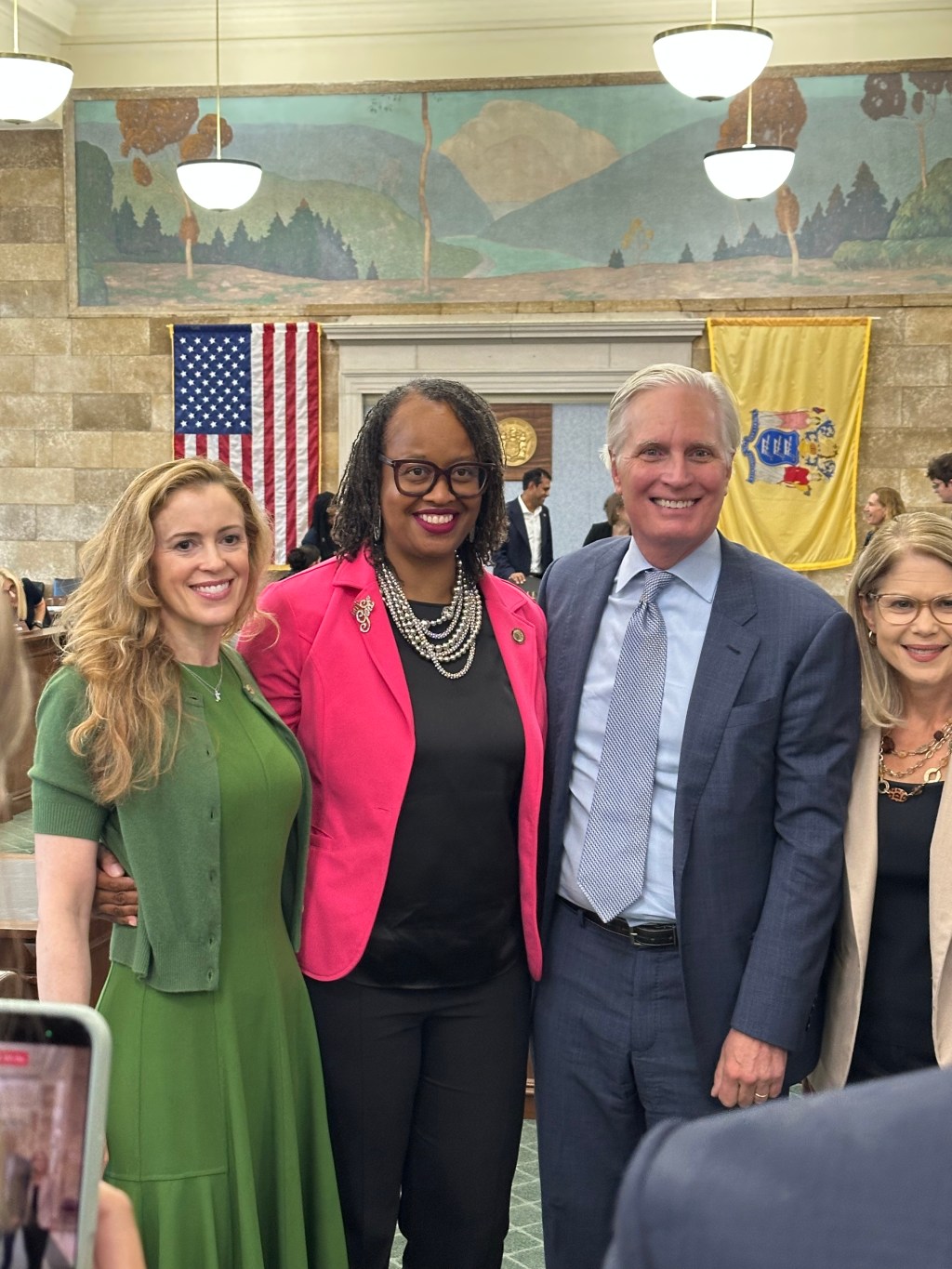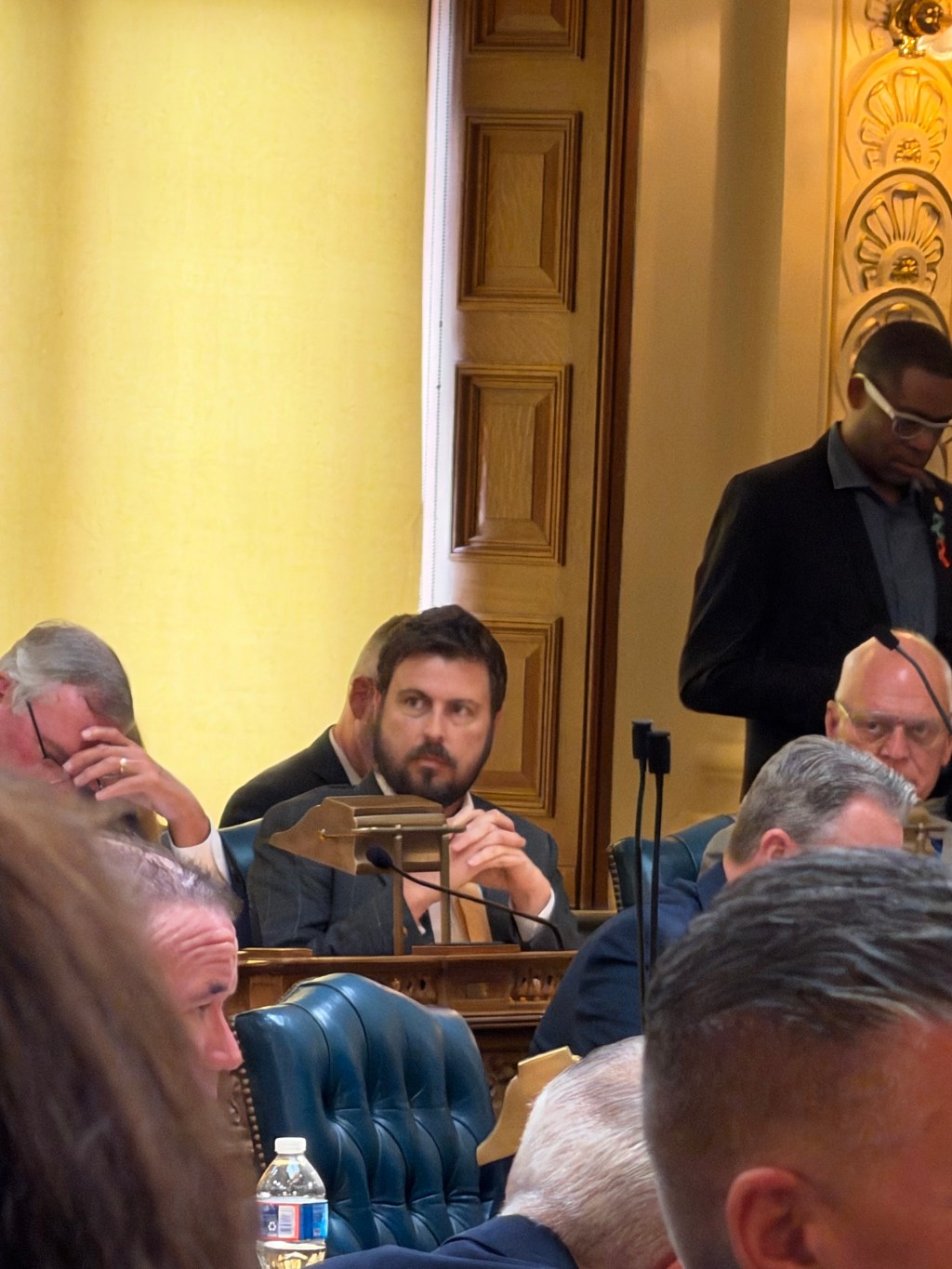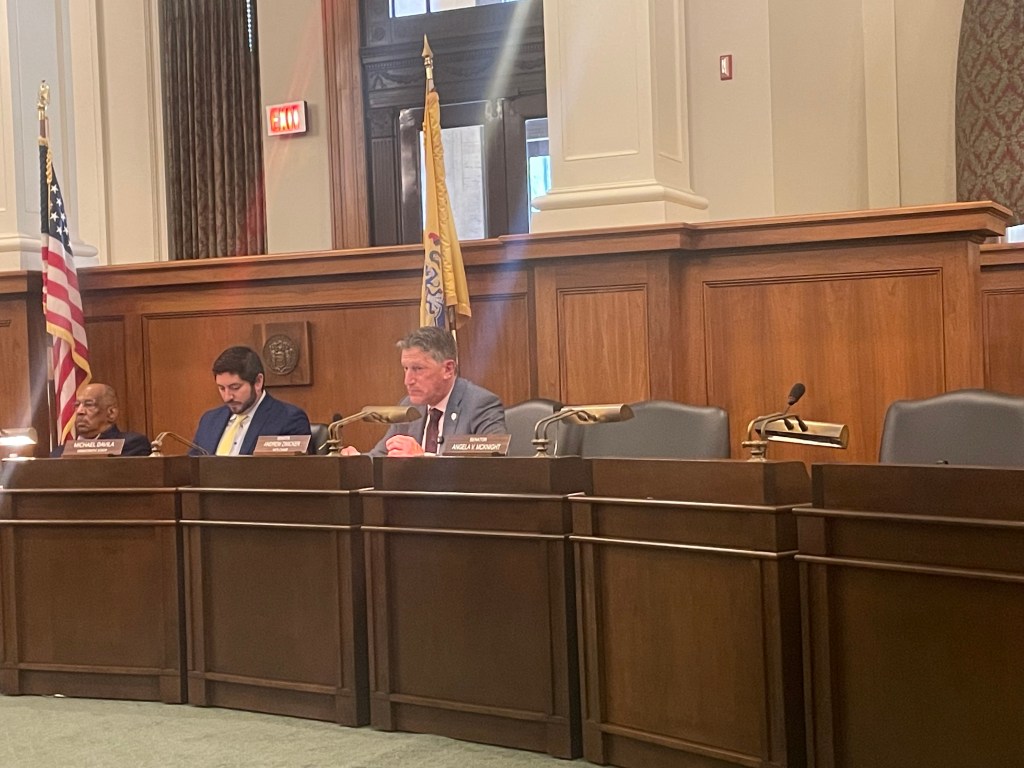
Sen. Andrew Zwicker (center), a Democrat from South Brunswick, sponsors a measure that would regulate the use of AI-based systems in employment, including hiring and firing decisions. Photo credit: Zo Terrana/NJ State House News Service.
By Zo Terrana
NJ State House News Service
TRENTON, N.J.- The Senate Labor Committee unanimously voted Thursday to move a bill that would regulate the use of AI-based systems in employment.
The bill, S4075, is centered around the protection of employees from automated benefit or service decision systems, including hiring or firing, by any AI system used to collect data about an employee by means other than direct observation by a person.
The bill would bar adverse action against an employee on the basis of the data collected by these systems via actions like key strokes, mouse movements or idle time trackers.
“This is an unprecedented time in our society,” said Sen. Andrew Zwicker, a Democrat from Hillsborough and sponsor of S4075. “We have never seen a disruptive piece of technology like this before. You can go back to the steam engine, the internet, the light bulb, pick what you want, and nothing is moved at the speed of AI.”
“As technology continues to change the workplace, we must make sure innovation does not come at the expense of workers’ privacy and rights,” said Sen. Shirely Turner, a Democrat from Ewing. “This legislation gives workers greater transparency and a voice when AI systems are used to make decisions that affect their lives, from hiring and employment decisions to access to public benefits, while helping protect against discrimination.”
Debbie White, the President of Health Professionals and Allied Employees, a healthcare labor union voiced her support for the legalization.
“The problem is that these systems often do not measure the reality of nursing care, or the quality of care,” White said. “When a nurse spends extra time educating a family, comforting a dying patient, preventing a fall or recognizing subtle changes in patients’ condition before that crisis occurs, that is excellent nursing care. The algorithm may say that nurse took too long to complete the task ”
White stated that AI can offer a counterintuitive position, saying an AI-generated choice could be “inefficient” when in actuality the choice the nurse made was the better option. This, in turn, impacts the health of patients in hospitals.
“In healthcare, decisions based solely on data points can overlook clinical expertise,” White said. “This legislation provides common sense protection and protects workers from invasive surveillance practices.”
Patrick Glover, a business agent and representative for United Food and Commercial Workers, a labor union, also supported the bill.
“Workers deserve to know when AI is being used to make decisions that affect their lives, rights and access to essential services,” Glover said. “AI can process vast amounts of information, but that information may be inaccurate, incomplete or shaped by long standing biases.”
Glover said the bill set “reasonable safeguards” to prohibit invasive surveillance outside of work areas and does not stand in the way of innovation.
However, Elissa Frank, the president of the New Jersey National Justice Institute, testified against the measure.
“Our concern is the scope of the bill,” Frank said. “The bill does not establish administrative requirements. It creates a private cause of action with substantial remedies including back pay, reinstatement, attorney fees, 200% liquidated damages and punitive damages.”
Jack Ramirez, a representative for the New Jersey Business and Industry Association, also testified in opposition and said it would cause uncertainty for employers.
“Our primary concern is the breadth of the bill’s definition. The bill broadly defines several key terms, including automated employment decision systems, and electronic monitoring tools in a way that can capture technology far beyond what most people, what traditionally understand, as artificial intelligence,” Ramirez said.
Zo Terrana is a senior journalism major at The College of New Jersey.