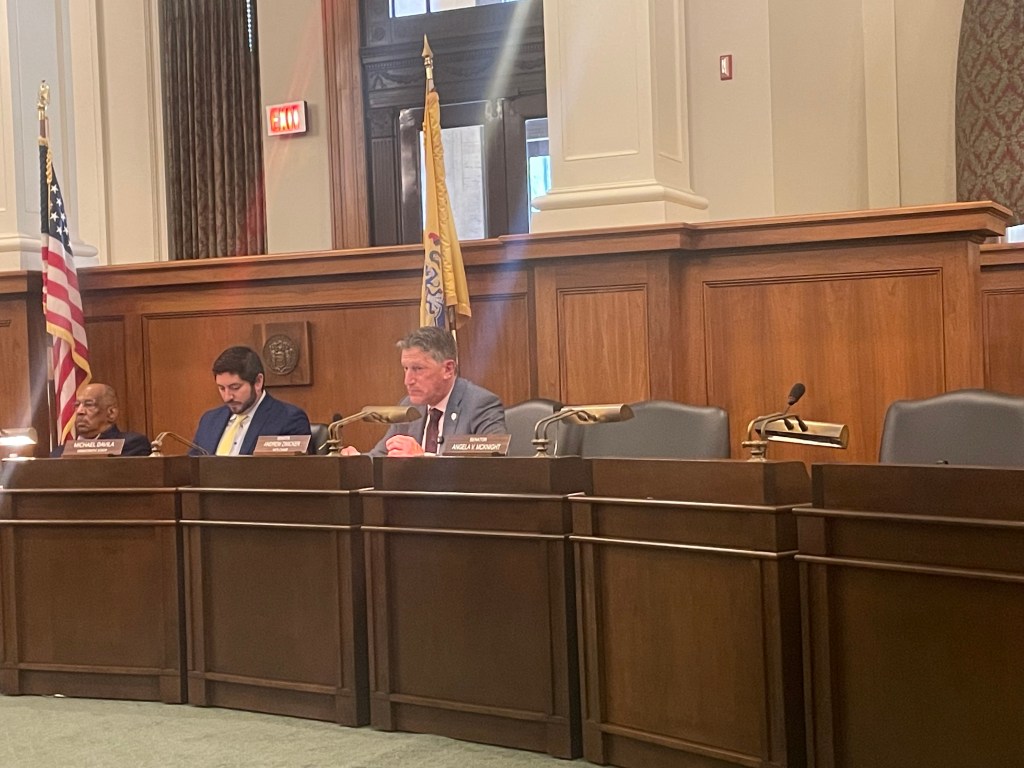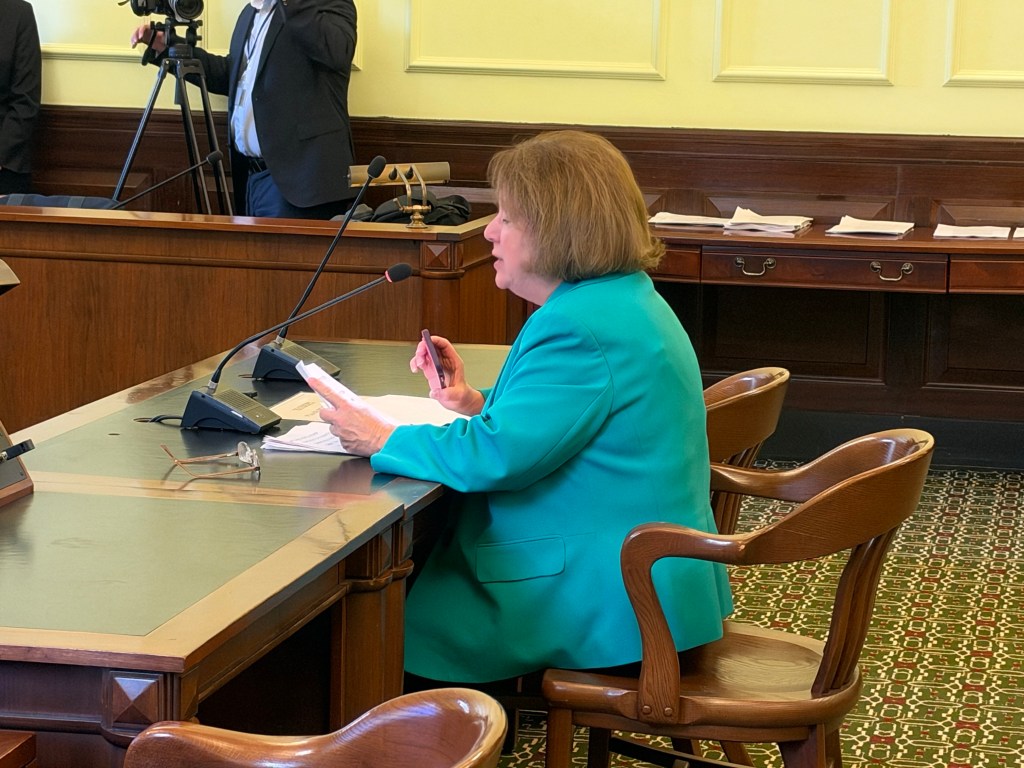
Democratic Assembly Members Annette Quijano and Melinda Kane (right) vote in favor of a measure Monday that would require the manufacturers of smart glasses and other tiny, wearable cameras to display a clear sign, such as a light, whenever the device is recording. Photo credit: Aidan Vanhoof/NJ State House News Service.
By Aidan Vanhoof
NJ State House News Service
TRENTON, N.J. – As wearable cameras and smart glasses join the marketplace, lawmakers have rising privacy concerns about tiny cameras that could be secretly recording anyone at any time.
The Assembly Consumer Affairs Committee moved A5478 Monday on a 5-1 vote, which would require all smart glasses made or sold in the state to have a clear indicator, such as a light, whenever a wearable device is recording.
Separately Monday, the Senate Commerce Committee unanimously moved S4065, which would prohibit the sale of health information gathered by wearable technologies without the user’s written consent.
The wearable camera bill would establish strict regulations making it unlawful to manufacture or sell wearable devices that do not have something clear, automatic and unmodifiable to show when it’s recording.
Plus, it would bar the sale and distribution of devices and technologies, including apps or software, designed to obscure or shut off recording indicators. The measure would also require sellers to educate users on the correct use of the device.
Meta Glasses, for example, come with a white LED that automatically lights while recording, and in recent months the company has been cracking down on attempts called “Ghost Metas” to disable or hide the light.
“I think it’s just a way of protecting individuals when they’re being recorded, it’s as simple as that,” said Assembly Member Melinda Kane, a Democrat from Cherry Hill.
Violations would carry a hefty fine. The first offense incurs a $10,000 fine; any following offense brings a $20,000 fine.
Assembly Member Jay Webber, a Republican from Morris Plains, was the only vote opposed, expressing concerns over regulatory inconsistencies and consent.
“I think there’s always a concern when the state of New Jersey puts requirements on some manufacturers that are specific to the state, as opposed to the other 49 states that the manufacturer is distributing into,” said Webber. “The headlines start to write themselves, right? New Jersey politicians vote to make it more difficult for people to record surreptitiously. That’s a concern for people who think you’re doing something illegal or unethical, whether it’s criminal or civil harassment or otherwise. In NJ, we’re a single consent state, meaning it is legal to record when only one participant is aware. Many other states require all parties to consent to recording.
Assembly Member Annette Quijano, a Democrat from Elizabeth, voted in support but expressed some concerns.
“We can’t always, as a body, be ahead of technology, and that’s the problem,” said Quijano. “I’m going to vote it out today only so it starts moving. But I also am going to talk to the sponsor to talk about manufacturers and what other things can be done … I understand the concern, and I know it’s a single consent state. And so this is one of those bills that we have to work on.”
Kane argued that indicators actually enhance safety.
“In terms of consumer protection, as a woman who lives by myself, I have a contractor that comes in wearing glasses that could be recording,” said Kane. “For all I know, they are searching to see my security system, valuables I have in my house.”
The measure explicitly states it would not apply to law enforcement body cameras.
Aidan Vanhoof is a journalism major at Rowan University.