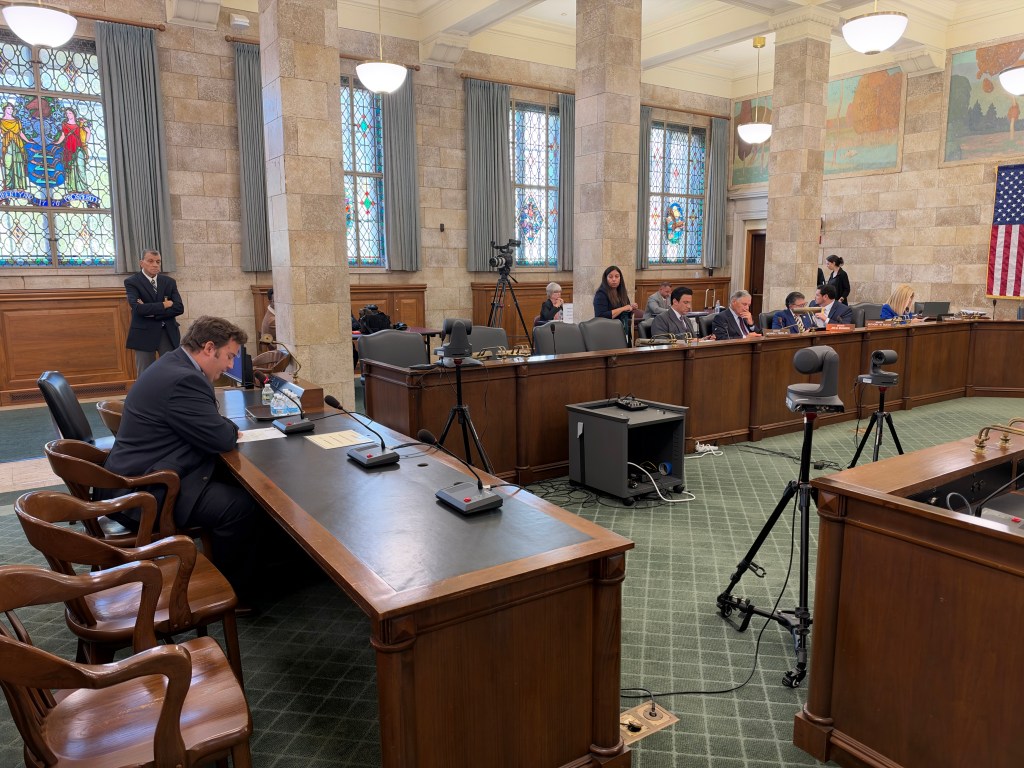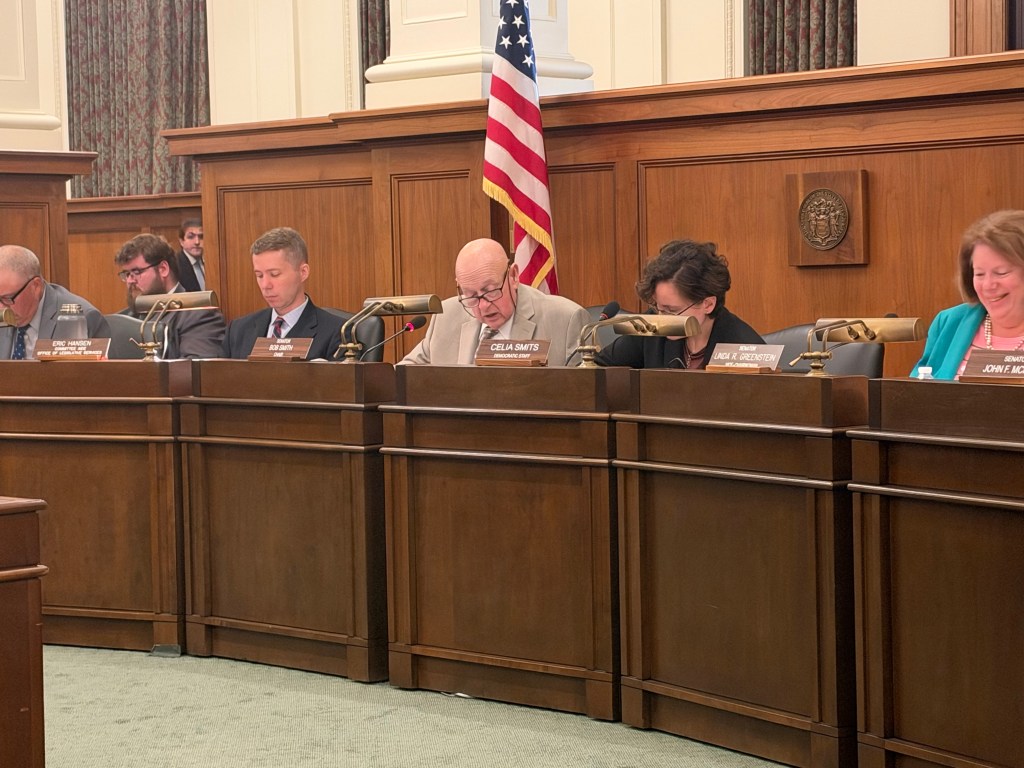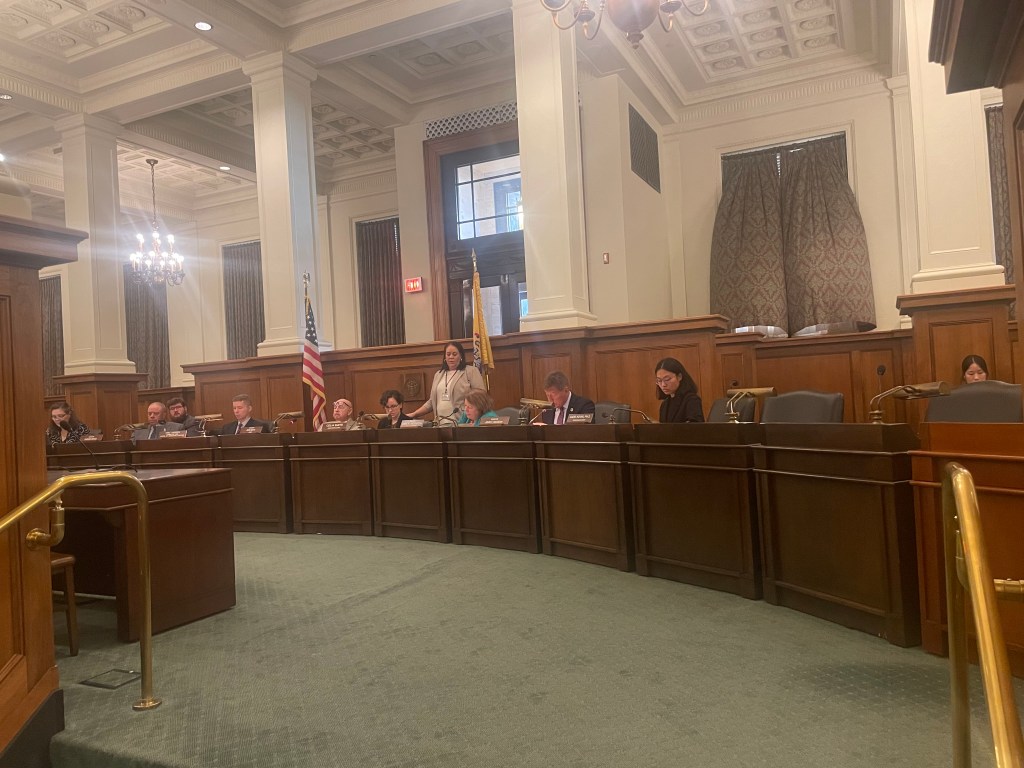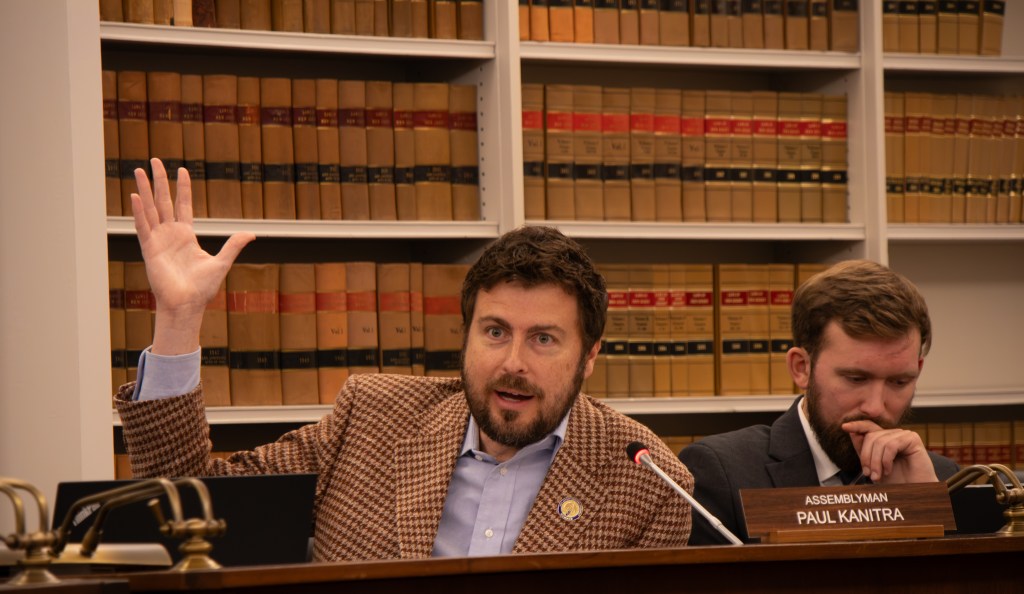
Assembly Member Paul Kanitra, a Republican from Brick, speaks about facial recognition technology at the Assembly Public Safety and Preparedness Committee meeting on Oct. 19 in Trenton. Photo credit: Aidan Vanhoof/NJ State House News Service.
By Ryan Conway and Aidan Vanhoof
TRENTON, N.J. – As artificial intelligence advances and surveillance infrastructure expands, some New Jersey lawmakers Monday sought to regulate their potential privacy violations and abuse.
Assembly members and lobbyists intensely debated AI data gathering, facial recognition technology and automated license plate readers during an Assembly Public Safety and Preparedness Committee meeting.
Committee Chair Joe Danielsen, a Democrat from Franklin (Sussex), said that AI can become a great tool, but also needs to be monitored and regulated closely, as it can also be dangerous.
“Today’s society is very different from just three years ago, with the rapid development and usage of artificial intelligence,” Danielsen said. “We need to explore how we can use artificial intelligence to help public safety in New Jersey, use this tool and provide early intervention in criminal matters, while also maintaining privacy, security and the public trust.”
The committee meeting focused on law enforcement use of facial recognition software.
“Misidentification is not the exception when it comes to facial recognition tools, but the norm,” testified Dillon Reisman, staff attorney of the ACLU of New Jersey. “By their very nature, facial recognition systems used in law-enforcement contexts do not and cannot guarantee an exact match.”
But Assembly Member Paul Kanitra, a Republican from Point Pleasant Beach, disagreed, arguing opposition to facial recognition, automated license plate readers and AI data gathering stifles law enforcement efficacy and inconveniences users.
“It feels like we’re some cavemen on the side who didn’t discover fire and now we’re just trying to stomp it out wildly real quickly,” Kanitra said.
Assembly Member Antwan McClellan, a Republican from Ocean City, argued that while no system is ideal, new technologies are too effective to ignore.
“I’m old enough to remember where you rely on a human, and they might think a black person shot somebody and it was actually a white person,” McClellan said. “That’s happened, and there’s people in jail for that. And that’s not a system, that’s a human eye. So there’s going to be bias, there’s going to be mistakes made and we’re going to try to correct that. There’s no system perfect. But for us to not be able to have the technology that we have and not utilize it really doesn’t make any sense.”
The committee unanimously moved A759 that would require the Attorney General to study law enforcement use of facial recognition technology and issue a report with recommendations. But Assembly members split 5-2 along partisan lines on A5423 that would bar police from obtaining search warrants based only on facial recognition technology.
The following bills were also moved during the 5-hour hearing Monday:
- A3058: Would establish a Deepfake Technology unit in the Department of Law and Public Safety. Deepfakes – photos or videos that have been falsely created or manipulated – have become increasingly common with AI. The measure was released with a 5-1 vote, with McClellan voting no.
- A3076: Would require the attorney general to study how law enforcement uses AI to produce police reports. The committee moved it unanimously.
The committee also discussed, but did not cast votes, on the following bills:
- A5483: Would prohibit the private use of automated license plate readers and only allow government to install those cameras in parking lots, toll booths and restricted areas. It would mandate data deletion every two days, and would force out-of-state agencies to obtain a warrant before accessing data.
- A5637: With the exemption of urgent “be on the lookout” warnings like Amber Alerts for missing children, the bill would require police to obtain a warrant before accessing automated license plate reader data, and require data deletion after 90 days.
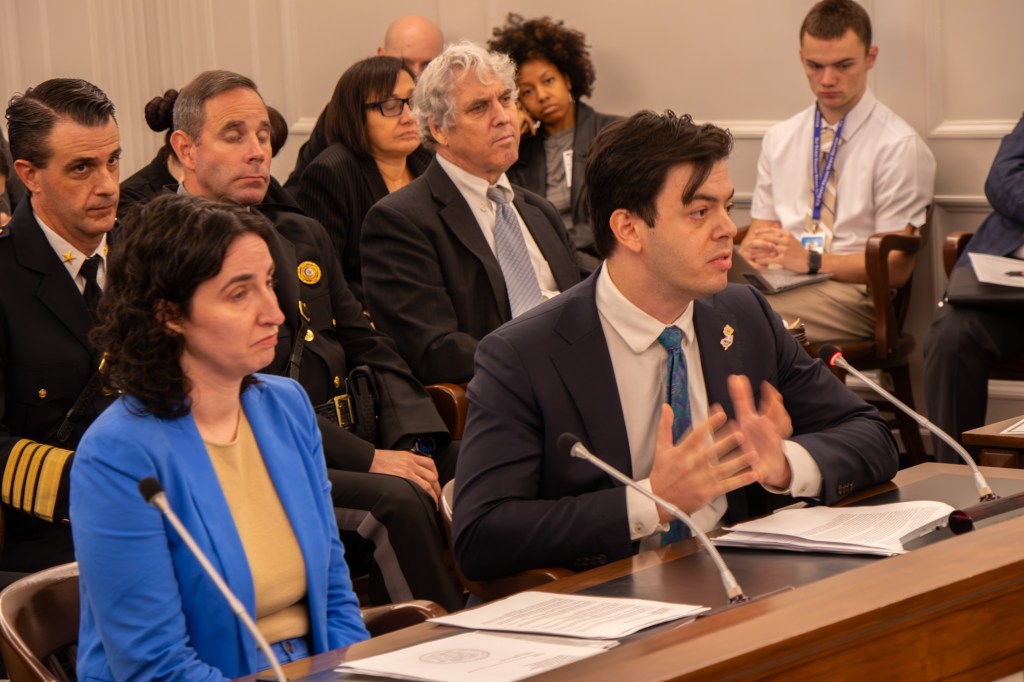
Photo credit: Aidan Vanhoof/NJ State House News Service.
Ryan Conway is a student at The College Of New Jersey, majoring journalism with a minor in communications.
Aidan Vanhoof is a journalism major at Rowan University.